Your builder is waiting on footings, and you want them in this week without concrete trucks blocking the street. Screw piling Brisbane builders trust can get your foundation in and ready to carry load on the same day. Our team installs engineered piles for new homes, extensions, decks, and commercial and civil structures right across South East Queensland.
The steel piles go into the ground with no digging, so you have no spoil to cart away from your site. Each one is placed with precision to the depth your engineer sets, then tested before we leave. That means your framer or slab crew can start the very next morning.
Have a read below to see if piles suit your project, or give us a call for a friendly chat. First, though, it helps to know what a pile actually is and how it holds a building up.
Key Takeaways
- Piles carry load as soon as they are installed, with no curing wait.
- Installation leaves no spoil and needs no concrete trucks.
- They suit homes, decks, commercial builds, underpinning and waterfront work.
- Your soil decides how deep and how big each pile must be.
- Torque readings and engineer certification confirm every pile.
- Depth to firm ground is the biggest driver of your cost.
Screw Piling Brisbane Builders Rely On
A screw pile is a steel shaft with a helix that you screw into the ground until it reaches firm soil. Think of a giant screw biting into the earth: the twisted plate pulls the shaft down as it turns. Some steel screw piles carry one helix, while others carry two or three along the shaft.
Once in place, the pile handles loads in two directions. It resists compression from the weight of your building pressing down. It also resists tension when strong winds try to lift a roof or deck upward.
A torque reading is the turning resistance measured as each pile goes in, which confirms it has reached soil strong enough to carry its design load. Strength in the ground shows up as resistance on the gauge. A low reading tells us to keep going deeper.
Piles come in different head designs and shaft sizes to suit each job and soil type. A bigger helix is not always better, though. The right size depends on the soil layer the pile needs to reach.
A bigger helix is not always better. The right size depends on the soil layer the pile must reach.
Steel screw piles also carry load straight after installation. That one fact explains why so many builders now pick them over poured concrete.
Why Choose Screw Piles Over Concrete Footings?
Concrete piers need days to cure, while screw piles can take load as soon as they are in. That gap in curing time changes how quickly your whole build moves. It also changes how much mess your site has to deal with.
Here are five reasons builders choose piles for their foundations:
- No curing wait: framing or slab work can start right after installation.
- No spoil or concrete trucks: there is no dirt to remove and no trucks to book.
- Low vibration: the quiet turning motion is kind to nearby homes and neighbours.
- Removable and reusable: piles can be taken out, moved or used again.
- Recyclable steel: old piles can go back into the steel supply.
The time saved adds up fast on a tight construction schedule. Ground disturbance stays small, so your yard is not churned up. Piles that go in at the wrong spot can simply be repositioned.
Concrete still has a place, and you should know when. Very shallow footings on firm ground can be cheaper in plain concrete. The savings with piles grow as foundations get deeper, usually from about 1.5m down.
So the cost edge mainly shows on deeper or tricky sites. Those sites turn up on all sorts of jobs, from backyard decks to warehouses.
Projects We Support Across Brisbane and the Sunshine Coast
Picture a homeowner adding a deck to a sloping block in Brisbane’s west. Digging deep holes on that slope is slow and messy, but screw piles go straight in at each post. Our screw piling services cover jobs like this, plus far bigger projects from Brisbane to the Sunshine Coast.
Piles support small backyard builds, large industrial structures and repairs to older homes. You can see real jobs in our gallery of piling projects, including Pimpama Shopping Centre and Ormiston Pool. The table below shows where piles fit.
| Project type | Typical structures | What the piles handle |
|---|---|---|
| Residential | New homes, granny flats, decks, pergolas | House weight and wind uplift |
| Commercial | Shops, warehouses, boardwalks | Large floor and roof loads |
| Industrial | Heavy plant, machinery bases | Heavy machinery and large structures |
| Underpinning | Settled Queenslanders, cracked homes | Lifting and holding shifted footings |
| Marine and waterfront | Jetties, boardwalks, bridges | Wet, soft ground and uplift |
Homes, Extensions and Decks
Screw piles suit new homes, granny flats, decks and pergolas. They work well where a slope or soft soil makes concrete footings awkward. Extensions also benefit, because the turning action won’t shake the existing house.
A pergola might need only a handful of piles, while a full home may need dozens. Either way, each pile is set to carry its share of the load. Your builder gets a level, solid base to start on.
Commercial and Industrial Builds
Commercial jobs like warehouses and boardwalks need many piles placed fast. Industrial screw piles support heavy machinery and large structures that put big loads on the ground. Boardwalks, bridges and large infrastructure use them too.
On busy sites, quick installation keeps other trades moving. There are no trucks to queue and no holes left open overnight.
Underpinning and Ground Anchors
Screw piles can underpin and stabilise structures that have settled or shifted, with little disruption. A sagging Queenslander, for example, can be lifted back to level on new piles. Ground anchors also hold retaining walls and slopes, and they add strength to existing footings.
Underpinning needs an engineer to find out why the building moved before any piles go in. A burst pipe, poor drainage or shifting clay could be the cause. Fixing the footing without fixing the cause only buys time, and the ground on your site plays a big part in that.
Matching Piles to South East Queensland Soil Conditions
Most soils across Brisbane and the coast suit screw piles, but your soil decides how deep and how big each pile must be. Piles work in clay, sand, silt and some rocky ground. We check the soil before any installation starts.
These are five common soil types and conditions across South East Queensland:
- Reactive clay: swells when wet and shrinks when dry, so piles go below the moving zone.
- Sandy coastal sites: loose sand often needs longer piles or a larger helix.
- High water table: piles go in without open holes that fill with water.
- Acid sulphate soils: piles may need extra coating to resist corrosion.
- Deep fill: fill deeper than 1.5m means piles must pass through to natural ground.
Reactive clay is the one most Brisbane homeowners meet. It swells in the wet season and shrinks through dry spells, which moves anything sitting in it. Piles must reach stable ground below that active zone so your house stays put.
Screw piles also perform well in wet and flood-prone areas. Since nothing is poured, water in the hole doesn’t spoil the work. That makes them handy near creeks, rivers and low-lying coastal blocks.
There is one main exception to watch for. Hard rock close to the surface can stop a pile short of its design depth. A bored or drilled pier may suit better there.
Once your ground conditions are known, the path from first call to finished piles is fairly simple.
How Our Screw Pile Installation Works
An excavator arrives at 7am, and by afternoon your piles are in and tested. For an average home, the whole pile installation often wraps up in one day. Most of the real work happens earlier, during design.
The process runs in four stages, and each one gives you something to keep. All our work follows AS 2159, the Australian standard for piling design and installation.
| Stage | What happens | What you receive | Typical timing |
|---|---|---|---|
| Site classification | Soil tested on your block | Soil report | Before design starts |
| Design and quote | Pile size, depth and layout set | Pile design and quote | After the soil report |
| Installation | Piles screwed in and torque-tested | Logged torque readings | Usually one day for a standard home |
| Certification | Engineer reviews the records | Certified documents | Shortly after installation |
Site Classification and Pile Design
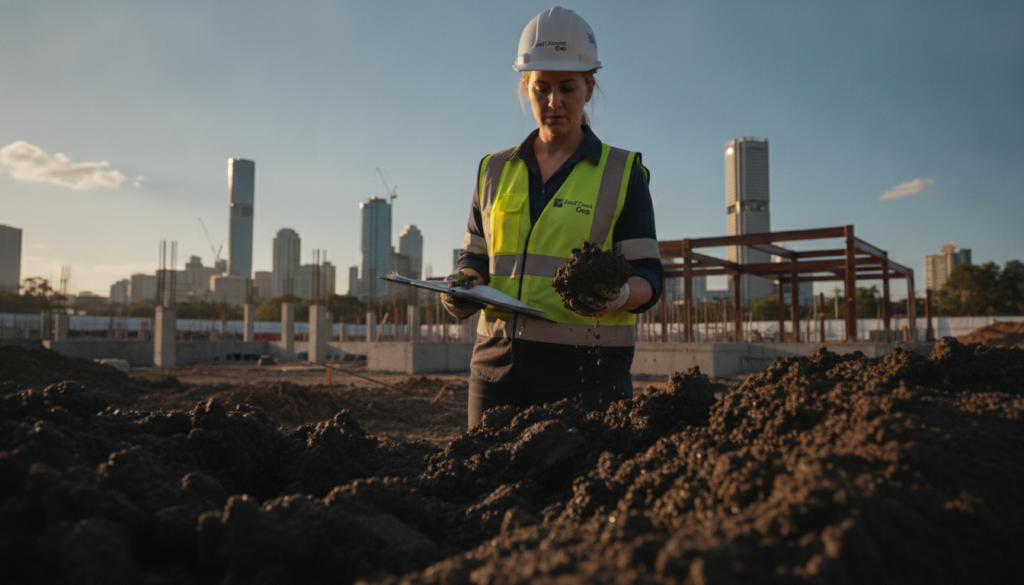
A site classification tells us what soil sits under your block and how much it moves. We recommend getting one before you ask for an accurate quote. The design then sets each pile’s size, depth and spacing.
A common mistake is booking installation before the soil report comes back. If the soil turns out softer than expected, the design changes and your build is delayed. Getting the report first saves you that headache.
Installing and Torque-Testing Each Pile
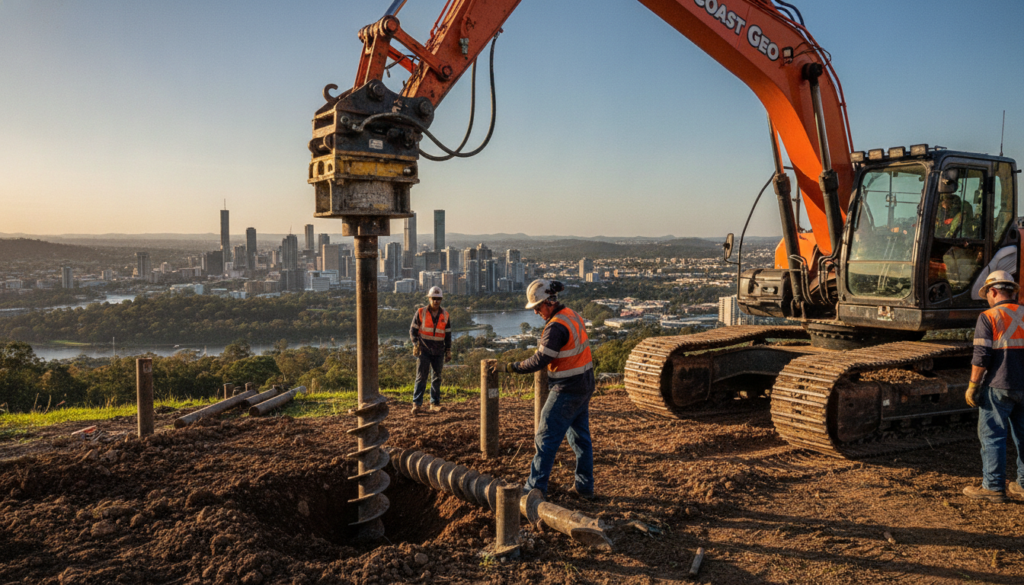
On the day, a hydraulic drive head on an excavator turns each screw pile into the ground. The operator watches the torque gauge as the shaft goes down. Each pile goes to its design depth and capacity.
We log the torque reading for every pile, not just a sample. Those records prove each one reached firm soil. The equipment is set up so the team can move quickly from one pile to the next.
Certification and Handover
After installation, an engineer checks the logged readings against the design. They then certify the documents for your builder and building certifier. You get paperwork that shows your footings meet the standard.
With certified piles handed over, your builder can get started. How much all this costs depends on a few key things about your job.
What Affects Screw Pier Costs
The biggest factor in your cost is how deep the piles must go to reach stable ground. Deeper piles need more steel and more time on the machine. Shaft size, helix size and the number of piles also shape the price.
Some savings are built in. Faster installation cuts labour costs and shortens your project timeline. With no digging and no curing, those costs drop off, and work moves on sooner.
Depth, Size and Number of Piles
Here are five main things that drive your quote:
- Depth to firm ground: deeper piles cost more in steel and time.
- Shaft diameter and helix size: bigger parts suit heavier loads and softer soil.
- Number of piles: more piles mean more steel and machine hours.
- Design load: a two-storey home needs stronger piles than a pergola.
- Site access and soil: tight spots or tricky soil can slow the job.
You may see screw piers for sale as DIY kits, like the light ground screws sold at Bunnings. Those suit small sheds or fences, and they work fine there. A house or deck has different requirements and needs engineered piles with certification.
DIY ground screws suit sheds and fences. A house or deck needs engineered piles with certification.
Access and Site Conditions
Access matters because the excavator has to reach every pile spot. A narrow side path or a steep yard can slow things down. Soil conditions also count, since hard or uneven layers take longer to work through.
Here’s a handy tip for tight backyards. Smaller machines can reach most yards without the extra cost of earthworks. Good piling services will tell you what machine suits your site, which is one sign of a team you can trust.
Choosing a Piling Contractor You Can Trust
In Queensland, the contractor installing your piles must hold a QBCC licence. That licence comes from the Queensland Building and Construction Commission. It should be your first check before you hire anyone.
When you compare contractors, ask about their QBCC licence, engineer-certified design and insurance. Ask to see sample torque records, and ask how many years they have worked with soil like yours. Good services answer these questions without fuss.
Be careful with a cheap quote that skips the soil report or certification. If a certifier rejects the footings, you may pay twice to fix them. The right solutions cost less over the life of your build.
Operators further afield, such as those doing screw piling in Sydney, follow the same AS 2159 standard. Even so, local experience with SEQ clay and coastal sand makes a real difference. Once you’ve found a team that ticks every box, getting a quote is easy.
Conclusion
If you want footings in fast with no curing wait, screw piles are worth pricing. Screw piling gives you a fast, certified foundation on most soils across South East Queensland. Each steel screw pile is logged and signed off, so your builder knows the system is sound.
Your next step is simple. Have your site classification or building plans ready, as they help us price the right solution. Then call our team on (07) 3713 4900 for a quote.
We’ll talk through your block, your build and your timeline. Give us a ring on (07) 3713 4900 today, and let’s get your footings sorted.